Showing posts with label ART ists. Show all posts

Friday, 4 July 2014

Sunday afternoon.

I visited the National Gallery of Modern Art last Sunday. Getting there was interesting. Thanks to my niece's somewhat convoluted sense of direction, I got to see many roads and lanes that I'd never before had the opportunity to drive down. No complaints, though. When we arrived, this is what we saw:


 Most of the space here is given to this amazing garden, with wonderful spreading trees and lovely little landscaped niches. The gallery itself is spread out in what apparently used to be some very lucky bastard's house. A Viceroy or something. I'm not sure if this place can technically be termed a house. It was more an unassuming palace.

 Another lovely aspect of the place was the water. Tanks and fountains, and a soothing sound of water rippling. I can hardly explain how delightful, how exquisite, it was just to stand here.

In between all this beauty, I was intrigued to find some extraordinary lumpy pieces of stone. These turned out to be Modern Art. (That lump at the bottom right of the photo on your left? It's a bird.)

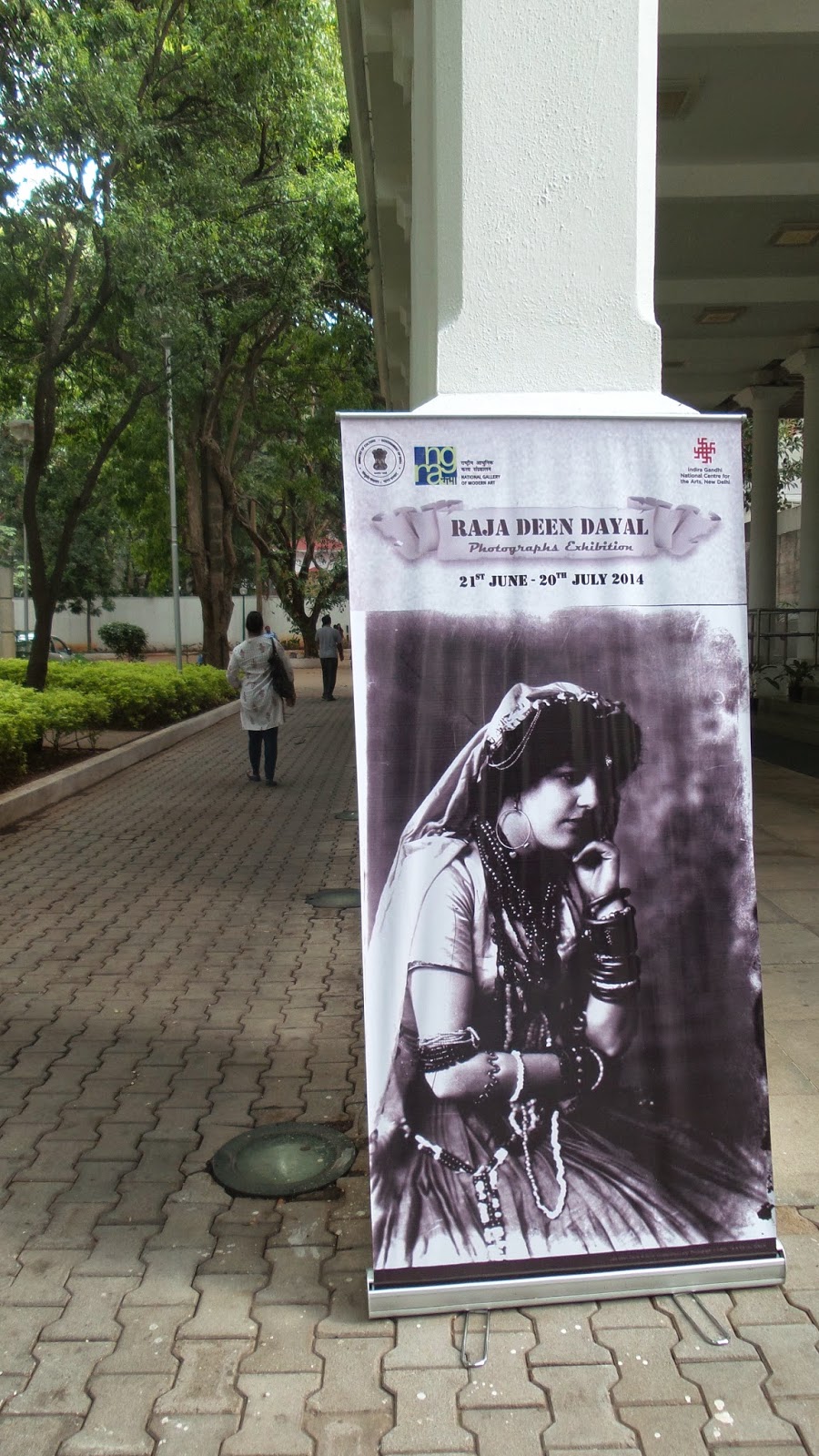
It did not bode well. But we were pleasantly surprised/relieved to find that we had arrived in time for what turned out to be quite a fascinating exhibit:  photographs from the 19th century. No photography allowed (but of course) so I made do with a photograph of a photograph on the exhibit banner:

Raja Deen Dayal was, according to a letter of reference that was part of the exhibit, a very nice and clever lad who went from being a studio photographer to being the court photographer for the Nizam of Hyderabad.

That's not him in the photo.

The exhibit was wonderful:  so many great photographs with stories just clamouring to get out. Lots of maharajahs, some of whom looked quite dissipated. Lots of brocade and carpet and curly-tipped shoes. Some breathtaking shots of historic architecture around India.

Like all good things, this too passed. In a half reverie, we walked on to other halls and to a rather rude awakening by the type of modern art that I always think of when I hear the term Modern Art.

I found two and a half paintings that I liked. (The two were by an Anupam Sood, and the half was the top half of a painting by I-forget-who, some lovely monochromatic ravens who fortunately would never have known that they shared a canvas with a line drawing of a rather grotesque woman, or perhaps it was a man.)

Oh. Perhaps that was the point of her (I-forget-who's) painting. The smooth flowing brush strokes of the raven contrasting with the Parkinson's diseasey quivering inked lines of the human. A Deeper Meaning, no doubt.

We ended with a stroll down to the gallery's horribly disappointing cafe. Another contrast! But perhaps without any deeper meaning. It could have been beautiful, but instead it looked like some little tea stand you'd find at the bus depot. And so we left. But not entirely disappointed. As we headed to the parking lot, I found Mr. M. Jayaram and convinced him to pose for me. I wouldn't let him stand at attention, so instead he sat at it. I love this picture!


Wednesday, 9 October 2013

Tomoyo and Tibet.

She looks fragile, but I don't think she is. Her skin seems
translucent, framed delicately by strands of soft, straight hair
that have fallen out of her ponytail. She speaks softly and gently,
but her words are purposeful and strong.

I see all of this in  her work. Each piece of Tomoyo Ihaya's
artwork is unique, and has been crafted with care and thought,
lovingly, to tell a story.


Although the story is one, it has over a hundred narrators:  the men
and women, the young and old, the mothers, fathers and children,
the friends, the monks. Each one a Tibetan who saw self-immolation
as the only way to protest the Chinese occupation of their home.


The ethereal texture of Tomoyo's work contrasts so starkly
with its dark, distressing subject. Perhaps that's what made it
sear itself into my mind and heart. It was hard to walk up to
each picture and look at it, and read the little pencilled captions
underneath. I read how old they were, and who they left behind.
It would have been easier to walk away.

I read of cruelties and injustices. I read of their last words,
and their last moments. It was painful, but, I felt, vital for me
to visit each and every person represented there. It was important
for me to put my fears and discomforts aside, and pay my respects.

Sometimes, I do this in graveyards:  every tombstone I pass, I say
the name out loud, imagining that there is a soul stirring somewhere
at the once-familiar sound, who finds some comfort in knowing that
their name is still on someone's lips, if only a sympathetic stranger's.

I do this because of a movie I watched earlier this year, in which
a dying woman tells her friend:  We die three times. The first
is when you take your last breath. The second is when your body
turns to dust. But the final death is when your name is spoken
for the last time.

Those 126 Tibetans are gone. Their evidence stolen away and
hidden, their headlines muffled, and the world could easily go
on its way as though they had never existed.

But Tomoyo speaks their names. She speaks their names with
the beauty, skill and gift of her art, and draws me in, making it
easier for me to look at the things I would rather hide from,
holding my hand as I walk past the tombstones.

Her work is showing at 1 Shanthi Road, and today is the last day.
Don't turn away. Don't close your eyes. Your soul needs it. And
so do theirs. Go on up there and take her hand.

Post script:  After I finished writing this, I came across another piece 
on Tomoyo, beautifully written by Sudha Pillai. Click here to read it.

Saturday, 29 September 2012

Blown away.

As I typed this title, I was already worrying that in today's crazy
world, people might think this post is about a bomb. Actually,
in more ways than one, it's quite the opposite. Bombs destroy.
This creates and connects.

I went to an exhibit at my favourite art gallery and was absolutely
blown away by it. It was the most creative, clever, endearing and
picturesque exhibit I've seen in a long time. It was beautiful and
simple and it wasn't only art, it was literally "art, earth, ink and soul"!
How could I not love it?

The artist is Chang Yoong Chia of Malaysia. Sadly, I didn't get
a chance to meet him, but am so grateful that I got a chance
to see his work, and just in time too. I managed to catch his
exhibit, The Botany of Desire, just an hour before it closed!

I walked in to the gallery and this is what I first saw. That's
my friend Suresh, leaning against the wall. We went to art
college together. For a year, anyway. Then I dropped out
(refer my darkest poems) while he went on to finish, and later
even became the principal. He was a very principled principal.
The gallery is his, and part of his NGO that supports and
encourages young and upcoming artists - local, national
and international; rural, tribal and urban. He has residencies
and so we get to see the most wonderful variety of art, and meet
the most wonderful variety of creative people.

The photographs I've taken don't really do Chang's work justice
(took them with the camera on my phone!). I couldn't resist
taking a picture of each and every leaf, and I wanted you to
see them all.
Chang blended Malaysian shadow-work with his experience of
Bangalore - those are actual leaves both on the screen and the floor,
from Lalbagh Botanical Gardens - and created a whimsical fairy tale
of sorts, from what he learned from his early morning walks there.


These are close-ups of two of the leaves. What you see is the silhouette
of the cut-out leaf, backlit. I thought they were quite lovely enough
as they were, but then Suresh walked me behind the screen. That's
when I got blown away - here is Chang's story, in pictures, in words,
on leaves. Enjoy!

by Chang Yoong Chia

 by Chang Yoong Chia
by Chang Yoong Chia
by Chang Yoong Chia

by Chang Yoong Chia
by Chang Yoong Chia
by Chang Yoong Chia
by Chang Yoong Chia
by Chang Yoong Chia
by Chang Yoong Chia
by Chang Yoong Chia
by Chang Yoong Chia
by Chang Yoong Chia
by Chang Yoong Chia
by Chang Yoong Chia
by Chang Yoong Chia
 Aren't they lovely? Everything about them enchants me. The skill
of the cut-work on the leaves, the style of the illustrations, the story.
I love the way Chang brings in little nuances of Bangalore
life  - early mornings in Lalbagh (the gates open at 5 a.m.
for walkers, joggers, and yoga enthusiasts) - parents going
for broke over the obscenely lavish Indian wedding - the history
of the tree - the call centre - the squirrel and the Brahmani kite.

My favourite leaves are the squirrel, the queen and the call centre.
Which are yours?

My favourite part of the story, though, is the last leaf. I can't wait
for Chang to come back and tell us more.

Monday, 16 July 2012

One toe in.

Yes, I have finally made a timid venture into the realm of art
collecting. Don't get too excited. And don't make plans to raid
my home when I'm out. I haven't bought anything over
a thousand rupees (that's like twenty US dollars). I have no
intention of being one of those people who "invest" in art.
I am a "cheap and best" person. And any art I collect will
be art that speaks to me.

This is what spoke to me on Saturday evening:

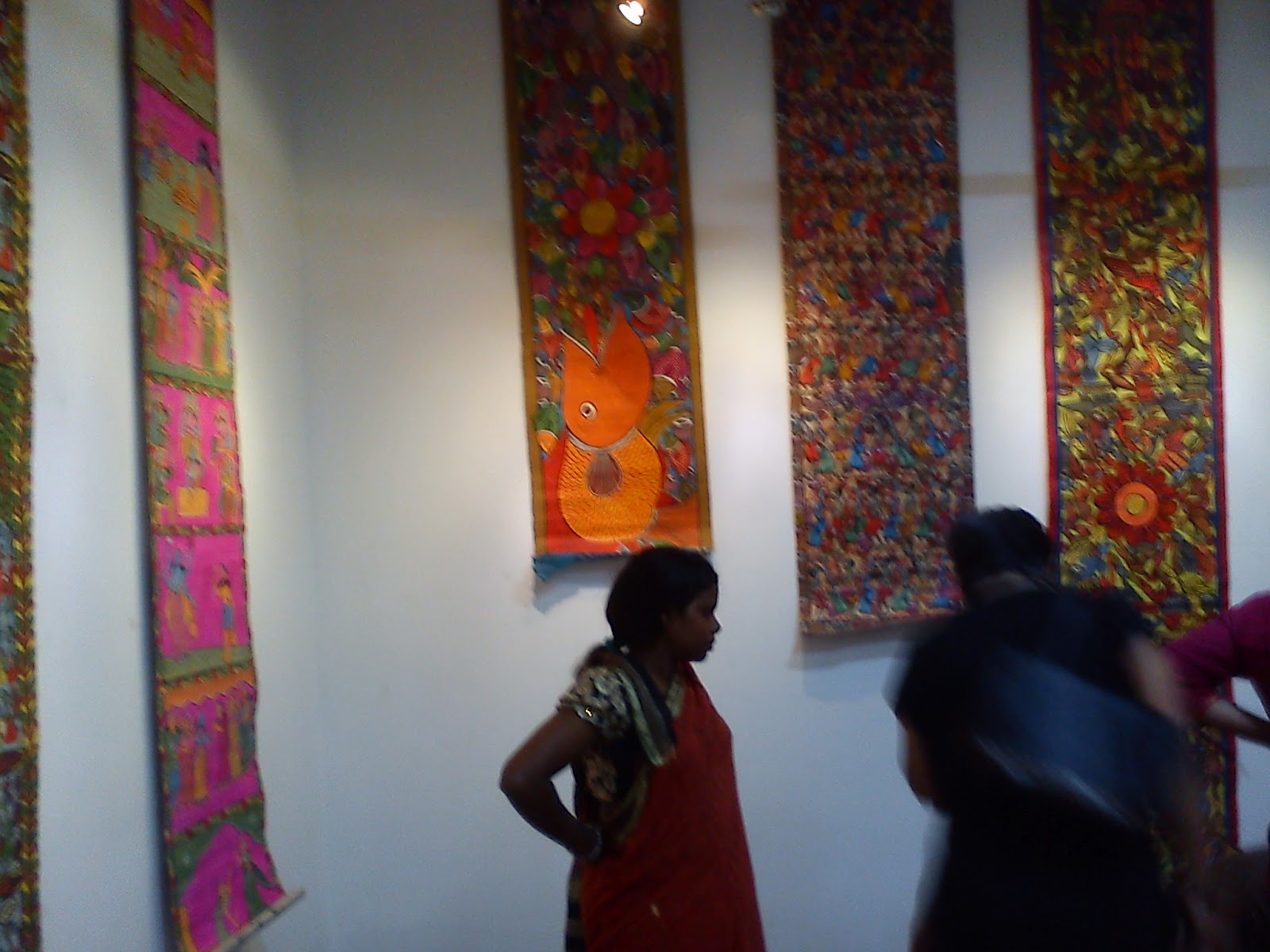
I had gone to 1 Shanthi Road for a performance and art exhibition
by Khadu and Radha Chitrakar, two folk artists from Bengal.
The art form, called Patachitra (painting on cloth), was
the quaintest exercise in multi-tasking that I've seen in a long
time. It's painting, composing, singing, story-telling, literally
rolled into one.

Long painted scrolls reveal a story - either one long image,
or a series of frames, almost like a comic strip. The artist sings
as she (or he) holds up the scroll to the audience, pointing out
characters on the scroll as s/he sings about them, and slowly
rolling the scroll up in her hands as she goes.

It's the story that sparks of the creative process, that inspires
someone to compose a song. Some of the songs we heard were
composed many years ago, shared and passed down from
one generation of artists to the next. The song then inspires
the painting. Together, they become Patachitra. It's a pity though,
 that although the scrolls may go on to dress someone's wall,
the song gets left behind, captured only on video or in a memory.

So I shall never know, when I look at my paintings, the story
of the cat. Did he get the cover off that clay pot? No? Is that
why he looks so resigned to the treat so near and yet so far?
How did he get hold of the pot and what was in it, anyway?
That delicious sweet curd that Bengal is famous for?

And what's with those two Bengali aristocrats? I mean, they
look Indian, but those minarets, the hookah and coffee pot
tell a different story. I shall just have to make my own stories
and sing my own songs when I gaze at my deliciously quirky
paintings. It will be fun.


But back to Saturday's performance - their voices weren't the prettiest I've heard, and they weren't fitted out flamboyantly in feathers or beads or festive colours. They just sat there in their everyday clothes, no make-up or special lighting, and they sang their songs and showed their stories. They didn't always stay in pitch or rhythm; they were unfazed at taking a pause to clear their throat with a soft cough. They just did what they do. And it was delightful.

If you haven't already, I'd recommend you zoom in on the pamphlet for a closer read - and a closer look too, at that painting in the middle. Does it look familiar? (Oh, and Suresh, if you're reading this, thanks. I copied the pamphlet image from your Facebook page).

Many of the Patachitras tell stories of Hindu mythology, tales of gods, goddesses and demons. But the demons in that particular Patachitra are the planes crashing into New York's twin towers. These artists don't limit themselves to tales of ancient traditions. They take in the world around them as it is today, and make it part of their art. You'll find patachitras on a recent flood, on the AIDS issue, the Babri Masjid, and yes, that awful day one long ago September.

I couldn't follow all the words when they sang this Patachitra (apart from the occasional "Boosh" and "Laden") but after they were done, our host translated the Bengali and explained the story that told, and showed, the planes, the towers, the victim's families, the war on Afghanistan, and finally Osama Bin Laden sitting cross-legged in a cave! And the theme that ran through the song was the question that so many of us must have asked the world over:  Why? Why did so many people have to die?

They ask good questions. And they answer difficult ones too. Khadu, Radha and their daughter Rabia (that's her in the picture with the hanging scrolls) - who sang to us about everything from a fish's wedding, the 9/11 attack, a snake-goddess, and a story from the Ramayana - are Muslims.They just do what they do. And it is delightful.